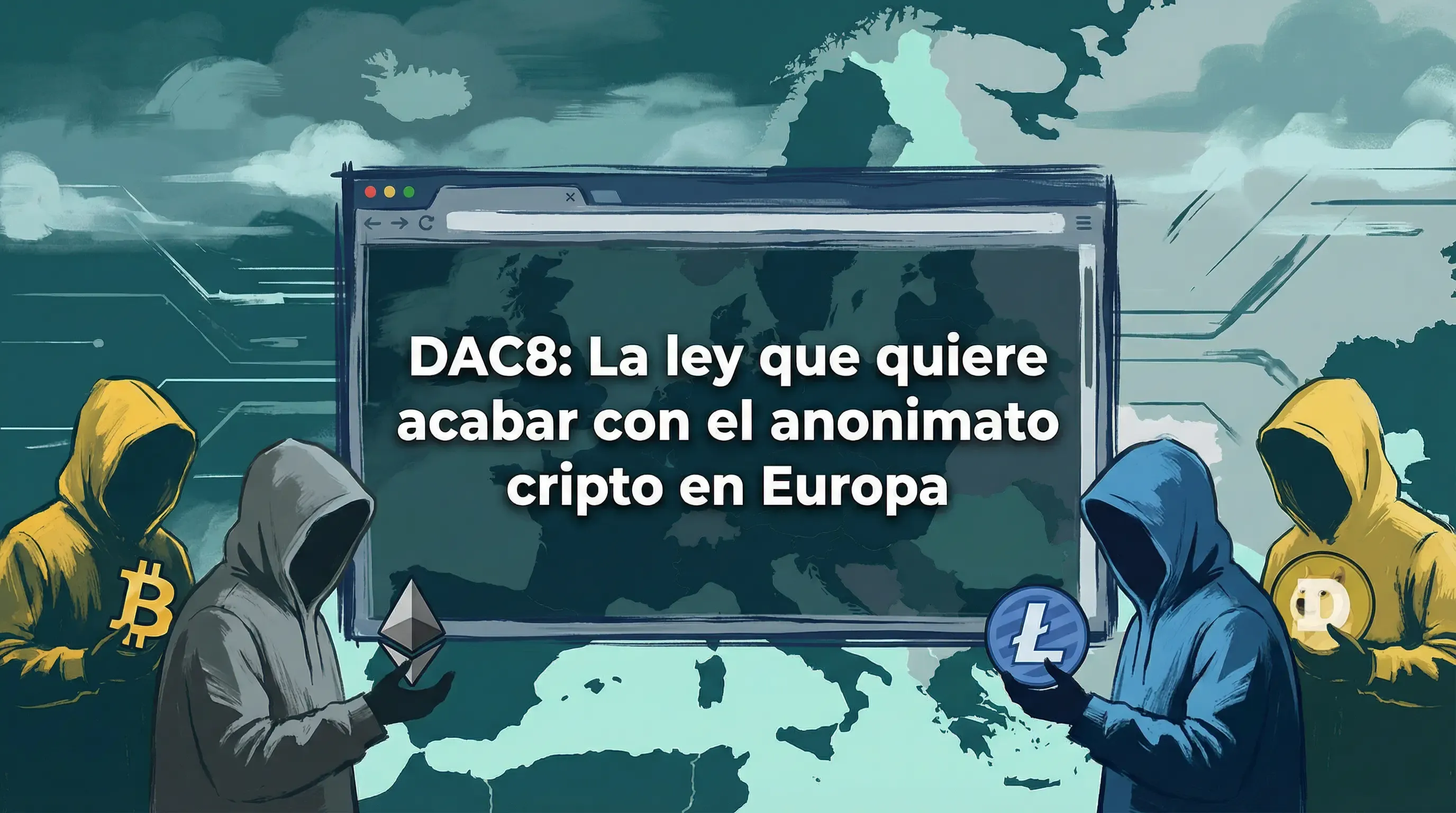
The digital asset ecosystem is going through its most radical transformation yet. What was born under the banner of decentralisation and privacy is about to face its biggest regulatory challenge. Directive (EU) 2023/2226, widely known as DAC8, is not just one more piece of paperwork; it is the European Union’s definitive tool for consigning anonymity to history.
At colvence, as specialists in preparing profit and loss reports for the Spanish tax return, we have gone through every point of this legislation. The conclusion is unambiguous: from 1 January 2026, the Spanish tax agency will have a front-row seat from which to watch every crypto movement you make.
🏗️ MiCA and DAC8: the two pillars of total oversight
Many investors mix these two terms up, but telling them apart is essential to understand the scale of what is coming:
- MiCA (Markets in Crypto-Assets): the regulation that sets the rules of the game for exchanges and stablecoin issuers. Its purpose is legal certainty and investor protection.
- DAC8 (Directive on Administrative Cooperation): the enforcement arm of the AEAT. Where MiCA says how exchanges must operate, DAC8 requires them to report automatically and en masse on the identity and the transactions of their users.
If MiCA is the highway code, DAC8 is the speed camera that fines you automatically when you fall short of what the tax agency expects. The two sets of rules interlock so that not a single legal gap is left anywhere on European soil.
The “tip-off list”: what data will the exchange hand over about you?
The exchange of information under DAC8 is granular to an unprecedented degree. This is not a simple “this user holds an account here” notice. Crypto-Asset Service Providers (CASPs) will report the following to the Spanish tax agency:
- Full identity: first name, surname, physical address and, most critically, your Spanish tax identification number (NIF or NIE).
- Transaction volume: the total value of your acquisitions and disposals (purchases and sales), stated in euros.
- Year-end balances: what your portfolio is worth on each platform at the close of the tax year.
- Transfers to self-hosted wallets: this is the point that worries people most. Exchanges will have to report whenever you send crypto-assets to an external wallet (a Ledger or Metamask, for example).
- Types of assets: not only Bitcoin or Ethereum; NFTs, stablecoins and any digital asset that can be used as a means of payment or investment are all included.
🔒 The myth of cold wallets as a safe haven (Ledger and Metamask)
There is a mistaken belief that if you take your funds off an exchange and move them to a cold wallet, the tax agency loses the trail. DAC8 puts an end to that.
The directive requires exchanges to record and report the destination addresses of your withdrawals. If you send 5 BTC from Binance to a private address, the AEAT will receive a notice: “Taxpayer X has moved 5 BTC to address 0x…”. From that moment on, the burden of proof falls on you. The tax agency will ask: is that wallet yours? If it is, you should have declared it on the Modelo 721 (where it exceeds €50,000). If it is not yours, the tax agency will treat the movement as a disposal or a payment, and will want to collect the tax due on the capital gain.
⚠️ Does it apply retroactively? The “rear-view mirror” trap
Technically, DAC8 is not retroactive. Exchanges will start collecting data on 1 January 2026 and the first mass exchange of information will take place in 2027.
The trap for the Spanish investor, however, lies right here. The tax agency has four years in which to review your tax affairs. If in 2027 the AEAT receives a DAC8 report saying you hold €500,000 in crypto, but you declared nothing in your 2023, 2024 and 2025 returns, an inspection will be triggered immediately.
DAC8 will work like a spotlight: they will not fine you for what you did in 2023 using DAC8, but they will use the 2026 information to show that you already held those assets in 2023 and failed to declare them. Past anonymity gives you no protection from future scrutiny.
🇪🇸 The picture in Spain: implementation timeline
Spain has been one of the most proactive countries in transposing crypto legislation. For an investor resident in Spain, the timeline looks like this:
- December 2025: deadline for Spain to bring its domestic law into line with DAC8.
- January 2026: the reporting obligation begins. Everything you do this year will be recorded permanently in the European tax database.
- April – June 2027: the first tax return campaign in which the tax agency holds the raw data sent by foreign exchanges.
❓ FAQ: frequently asked questions about DAC8 and the Spanish tax agency
Does it affect me if my exchange is outside the EU?
Yes. If the exchange provides services to European residents (even with its head office in the Seychelles or the Cayman Islands), it must register and comply with the reporting framework if it wants to keep operating lawfully in the single market.
What about DeFi and DEXs?
Although DAC8 focuses on centralised providers, the legislation already anticipates future extensions to capture activity on decentralised protocols. On top of that, any “off-ramp” (when you move from a DEX to a centralised exchange to withdraw to your bank) will trigger reporting.
Is it the same as the Modelo 721?
No. The Modelo 721 is an informational return that you file yourself. DAC8 is a directive that requires exchanges to report to the country that asks. The tax agency will cross-check both sets of data: if the exchange says you hold 2 BTC and you said on the Modelo 721 that you held 1 BTC, you will receive a formal demand automatically.
🛡️ How to survive the era of total transparency
The conclusion is clear: the “hope they never catch me” strategy is no longer viable. The only way to protect your wealth is traceability.
At colvence, we help investors bring order to the chaos of their transactions. We produce robust tax reports that stand as evidence against any formal demand from the AEAT. We do not just calculate your gains and losses: we get your records in shape so that, when the first flow of DAC8 data arrives, your return is a perfect mirror of reality.
Worried that your past movements will not match what the exchanges report in 2026? Do not let the “rear-view mirror” effect ruin your investment. At colvence we can run a preventive audit of your history and put your position right before it is too late.

Victor Lazaro
Tax adviser, colvence.com