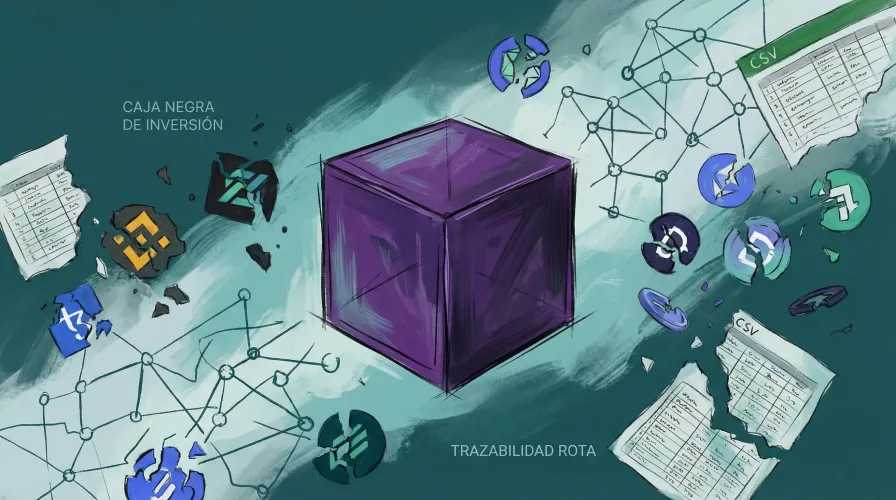
If you have already declared your crypto at least once, you have probably asked yourself:
“If I regularised the earlier years, why isn’t this year any cheaper?”
It is a fair question. You would think that 50 transactions this year should make for a simple, cheap report. It does not work that way, and it is not your adviser’s fault. It is FIFO’s fault.
What FIFO is, and why it makes your report dearer every year
In Spain, the tax agency requires the FIFO method (First-In, First-Out) for calculating gains and losses on crypto. In plain terms:
When you sell a cryptocurrency, you are deemed to be selling the oldest units you bought, not the most recent ones.
What does that imply? That to work out correctly what you owe this year, we need to know everything you have done since the day you started trading. Not just this year. Every year.
An example to make it click
Imagine you bought Bitcoin on four separate occasions:
| When | How much | At what price |
|---|---|---|
| 2019 | 0.5 BTC | €3,000 |
| 2020 | 0.3 BTC | €8,000 |
| 2022 | 0.2 BTC | €20,000 |
| 2025 | 0.1 BTC | €60,000 |
If you sell 0.4 BTC in 2025, which units are you selling in the tax agency’s eyes? The oldest ones: the 0.5 BTC from 2019 first, then part of the 2020 batch. Not the 2025 ones.
That is why we have to process your complete history from day one, even if we produced your report last year. Without that old data the calculation comes out wrong, and you could end up with a problem.
The snowball effect on cost
Here is the real problem. The specialist tools we use to rebuild your trading history (Cointracking or Koinly, plus our own software for certain specific cases) charge by the total number of transactions processed, not just this year’s.
Which means:
- in 2022 you had 2,000 transactions in total → low cost
- by 2023 you had accumulated 12,000 → medium cost
- by 2024 you were at 25,000 → high cost
- in 2025 you reach 100,000 → very high cost
Every year that passes adds more transactions to the pile, and the cost of processing them can only go up. It is not that your adviser wants to charge you more: the tools, the reconstruction work and the technical time all grow in proportion. It is out of our hands.
The answer: the Portfolio Reset
The “Portfolio Reset” is a perfectly legal strategy that consists of selling 100% of your crypto to empty your FIFO queue and start from zero.
Think of it as reformatting a computer that has slowed to a crawl: you lose a bit of time doing it, but afterwards everything runs fast and clean.
Who does it make sense for?
Not everyone needs a reset. Take stock of where you stand:
| Your situation | Reset? | Why |
|---|---|---|
| Little activity, 1–2 exchanges, everything clean | No | Your report is already cheap |
| Moderate activity but well documented | Probably not | The reconstruction is manageable |
| Many exchanges, years of trading, DeFi, lost wallets | Yes | You are overpaying every single year |
| Closed exchanges, incomplete CSVs, “holes” in the history | Yes | You have a traceability problem that will only get worse |
The real saving, in numbers
Take a typical case:
| Item | Without a reset | With a reset |
|---|---|---|
| Historical transactions | 25,000+ | 0 (you start clean) |
| Exchanges to process | 8 | 1 |
| Plan required | Whale (€529/year) | Fish (€75/year) |
| Cost over 3 years | ~€1,587 | ~€225 |
| Saving over 3 years | — | ~€1,362 |
The reset comes with a tax “toll” (you have to declare the gains for the year in which you sell), but it pays for itself in one or two years through the saving on future reports.
How to do the reset, step by step
Step 1: put your current position in order
Before resetting, you need the earlier years squared away. If you have never declared your crypto, you first have to regularise with amended returns. You cannot reset without having declared what came before: the tax agency may well ask where that money came from.
If your returns are already up to date, move on to the next step.
Step 2: produce the final full report
You need a final report covering your entire trading history, including the wholesale sale that constitutes the reset. This will be the last “heavy” report you ever need.
Step 3: sell everything into euros (executing the reset)
Liquidate 100% of your crypto positions by selling into euros and withdraw the money to your Spanish bank account.
- It creates a perfect banking trail. If the tax agency asks, your bank statement is the definitive proof.
- It is the only genuine way to do a clean reset.
Why doesn’t converting into stablecoins (USDT/USDC) work? Because stablecoins have an acquisition cost of their own and require FIFO traceability. If you convert your crypto into USDT rather than into euros, you have reset nothing: you have simply added one more swap to your history. When you later use that USDT to buy another coin, that is another taxable transaction to trace. The point of the reset is to cut the chain, not lengthen it.
Step 4: declare the gains (the reset’s “toll”)
Selling everything crystallises all your outstanding gains and losses. You have to declare them on your next Renta tax return.
What if I cannot prove what an asset cost me?
If you have lost the records of an old purchase, the safest option is to assume an acquisition cost of €0. Yes, you will pay more tax on that portion, but it is far better than the alternative:
| Scenario | Taxation | Risk |
|---|---|---|
| Declaring with a €0 cost | Savings tax base: 19–28% | None |
| Not declaring, or inventing a cost | Unexplained capital gain: up to 47% + a 150% penalty | Very high |
That said, if you have bank statements of the transfers to exchanges or purchase receipts, those do evidence a real acquisition cost. Keep everything you have.
Step 5: start clean (“Day 1”)
Once everything is sold, the tax toll is paid and the money is in your account:
- Keep the paperwork: the bank statement showing the funds arriving, and your last P&L report.
- Pick a single exchange to trade on (it simplifies your tax life enormously).
- Switch on read-only API keys and download CSVs from day one.
- Enjoy cheap reports: your next tax report starts from zero transactions.
What about losses? The “latent loss”
If the reset means selling assets that are underwater (worth less than you paid), you have an opportunity: those losses can reduce your tax bill. But there is an important nuance.
Think of losses as a discount voucher against your tax bill. Depending on what you do after selling, that voucher can be used in different ways:
Option 1: you wait two months before buying back
If you sell Bitcoin at a loss and wait at least two months before buying Bitcoin again:
- The loss applies directly on this year’s return.
- You can offset it against any other gains you have had.
- It is the safest and clearest option.
Option 2: you buy the same asset back within two months
If you sell Bitcoin at a loss and buy it back the next day (or within two months):
- The loss does not disappear, but it is “frozen”.
- It is added to the cost of your new Bitcoin units.
- You will benefit from it when you sell those new units in the future.
- You lose nothing; it is merely deferred.
Option 3: you buy a different asset
If you sell Bitcoin at a loss but buy Ethereum (or any other coin):
- Because they are different assets, the loss is “released” with no waiting period.
- You can use it to offset gains in the very same year.
- You stay in the market without having to wait.
Which one suits you?
| Option | Advantage | Drawback |
|---|---|---|
| Wait two months | Immediate, safe deduction | You are out of the market for two months |
| Buy back sooner | You keep your market exposure | The loss is deferred, not used now |
| Buy a different asset | Immediate deduction + you stay invested | You change asset |
The legal background: the rule here is Art. 33.5.e of the LIRPF, on homogeneous assets. Advisers disagree about it: some hold that you can buy back the next day without difficulty, given the legal vacuum around crypto; others recommend waiting the two months out of caution. In our experience, the safest course is to observe the prudent two-month period.
Checklist before you reset
Before you take the plunge, make sure everything is in order:
- Are all your earlier years declared? If not, you need amended returns first (€120/year).
- Have you filed Modelo 721? If you held more than €50,000 on foreign exchanges at 31 December, you should have.
- Do you have open DeFi positions? Liquidity pools, staking, lending… all of it has to be closed. Factor in gas fees.
- Do you hold crypto on hardware wallets? (Ledger, Trezor) Do not forget them.
- Is the timing right from a tax point of view? If you already have substantial gains this year, it may be worth waiting until next year rather than piling everything into a single return.
- Have you saved all your bank statements? You will need them as proof of the source of funds.
When is the best moment to do the reset?
| Moment | Why |
|---|---|
| October – November | Ideal. It gives you time to sell, receive the funds and document everything before the tax year closes on 31 December |
| December | Possible but tight. The bank transfers may be delayed and end up straddling two tax years |
| January – March | Too late for the previous year, but valid for starting clean this year |
| After April | If you have already filed your return, you can plan the reset calmly for the current tax year |
Bonus: if you do the reset before 31 December and liquidate everything, you also spare yourself the following year’s Modelo 721 (because you will hold nothing on foreign exchanges at year end). That is another €300 saved.
Frequently asked questions
Is the Portfolio Reset legal?
Yes, entirely. Selling your assets is your right. No rule prevents you from liquidating your portfolio. All you have to do is declare the resulting gains or losses correctly.
Can I reset without going into euros?
No. Converting into stablecoins (USDT, USDC) is not a real reset. Stablecoins have an acquisition cost of their own and keep the FIFO chain alive. Every time you use that USDT to buy another coin, that is a fresh swap to trace. For the reset to work, you need to sell into euros and receive the money in your bank account. Only then do you cut the chain and start from zero.
How much will I save on future reports?
It depends on your current volume. A client with a complex history paying between €329 and €1,199 for their annual report could drop to €75 after the reset. The saving can exceed €1,000 in as little as two or three years.
What if I cannot prove the purchase price of my crypto?
The most prudent course is to declare a €0 acquisition cost. You will pay more tax on that portion, but you avoid the risk of an unexplained capital gain (GPNJ), which can be taxed at up to 47% with penalties of 150%.
Do I need a reset if everything is already well documented?
Not necessarily. If your trading is orderly and your tax report is affordable, there is no point resetting for the sake of it. The strategy is built for people whose history is chaotic, scattered or so voluminous that every year costs more than the last.
Summary: is the reset worth it?
| Factor | Without a reset | With a reset |
|---|---|---|
| Transactions to process each year | The whole history (and growing) | Only the new ones (starting at 0) |
| Cost of the annual report | Rises every year | Minimal (Fish plan) |
| Traceability | Harder every year | Perfect from day 1 |
| Risk with the tax agency | Higher (holes, lost data) | Minimal (everything documented) |
| Modelo 721 | Compulsory if >€50k held abroad | Eliminated if you liquidate before 31/12 |
| One-off cost | None | The tax toll (tax on the sale) |
This clean-up is about more than tidiness. With DAC8 in force and the tax agency using on-chain tracing tools, holding a perfectly traceable, fully documented digital estate is the only safe way forward.
Would you like to know how much you could save?
At colvence we review your trading and tell you exactly what the reset would cost you compared with carrying on as you are. The quote is free and comes with no obligation.
Legal note: this analysis is based on the legislation in force (LIRPF) and the doctrine of the Spanish Directorate-General for Taxation (DGT). Every case requires individual study. Capital losses are subject to the anti-avoidance rules of Art. 33.5.e of the LIRPF.

Víctor Lázaro
Tax adviser, colvence.com